
Week 6-----New Media Ecosystem
Group Members: Ayesha Zafar, Gobi. T, Shirin Sodhi, Sumran Bhan.
The article called "Is CraigsNews' Coming Soon" written by Eric Hellweg was published in the MIT Technology Review on May 19, 2005.Hellweg's article is a poingnent display of how new media has transformed mass media, has collaborated with mass media and has over-taken mass media.
It directs our attention to an emerging phenomenon in news that is developing on the web. This phenomenon is called "collaborative citizen journalism (CCJ)". The discussion of the article focuses on the development and ever-growing popularity of this news genre. It gathers a list of the most popular sites and gives a brief overview of each.
CCJ is news that is gathered, written, edited, critiqued and published by a group of ordinary citizens. It is an on-going process where participants can contribute without the limitations of publication deadlines and pressures of news editors. CCJ is so far falling into three distinct approaches, which are:
Lccal news approach e.g Backfence.com
Broader Focus Approach e.g Oh MY news or WikiNews
Community-based media-vetting efforts e.g NewsTrust
This emerging phenomenon, which a cousin of blogs, is creating a new media ecosystem.
This ecosystem will play a complementary role for the main stream media rather than displacing it. A journalist, John Hiler brings the attention the importance of CCJ for the main stream media by using the analogy of food chain.
Weblogs and collaborative journalists publish an event or story at a grass root level. As most of the blogs are interlinked and many mainstream journalists keep track of these blogs, a new story emerges at the mainstream level. Again CCJ do the fact verification, filtration of the published story. CCJ is adding diversity to the content and fact verification can make or break the future of CCJ.
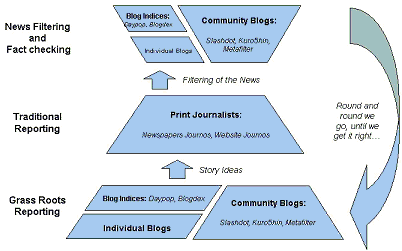
Image from Microcontentnews.com
Questions:
- Who will be responsible for the sysnthesis of news in blogosphere?
- Will the diversity of content and point of view presented by CCJ be any good for society or will it be just "news overload"?
- Will these sites catch the eyes of masses or will they create "more aware elites?
posted by Ayesha @ 2:11 PM

7 Comments:
I agree that we all will evolve while interacting with this kind of media and will become more media literate specially with the emergence of CCJ.But my concern lies if every one will be presenting news than who will be synthesizing it? As prof discussed in class that only opinions does not do any good. So the point come to my mind is that a little bit of regulation is important, which keep things and point of views at a track. But won't it kill the real objective of CCJ? Discuss.
Although we are surrounded by overwhelming amounts of news information, we are certainly not suffering from an overload of critical and intelligent thought. In fact, it is the lack of it in mainstream media that is more overwhelming. Therefore, whatever type of media that gives unheard and intelligent voices a chance to be heard, is worth it. Filtering through the garbage is the hard part.
I do not think that information overload would be a concern. CCJ is a liberating, decentralizing news system that allows people to select what they want to read, see, or hear about. The fact that it is made by "ordinary citizens" is refreshing.
In regard to the authenticity of CCJ, I think it all really needs to be taken with a grain of salt. Every form of news journalism is flawed to some extent. Every newspaper will have a political slant. I think it's just a matter of what you decide to read, and how you decide to interpret it.
I agree that we should have access to all kinds of news, coming from different sources and perspectives. This will, in my opinion, create a simulation of “perfect and balanced” consumption of information. However, where media is concerned nothing can be even close to perfect.
Nobody guarantees authenticity when any kind of news is broadcast whether it be on TV, Internet or a weblog. However, the way it is presented makes considerable amount of difference in our level of trust. When we see an event happening live in front of us on the TV it registers in us an image of “real / reality.” Hence, in that regard viewing something on television is comparatively more trustworthy than a news on a “blog.” The Internet has already transformed journalism with individual web publishers sometimes scooping Big Media, sometimes getting the story wrong and in eventuality shaking the consumer’s faith in that source of news.
When people respond to information / news on blogs, their response to a certain extent is synthesized because addressing a question or situation involves one’s personal perspective and the ability to analyze. But does this synthesis lead anywhere? If there are, for instance, a certain numbers of solutions available to an issue raised by someone on a blog, who is responsible for putting that solution in effect?
I strongly agree with shirin here when she raises question of "application of solutions" which are raised by any media analyst, journalist or anyone else.Its good that issues are debated more widely now but for in reference of application of solution, we cannot ignore power and authority issues.
I believe that almost all societies, in this world, base their system on Economics and when economy is all and all, commercialization feeds itself and turns into an indispensible part of our lives.Which leads to brand and celebriry obsession etc etc. It like a vicious circle inw hich we are stuck and things like CCJ only helping in critiquing. How much are they REALLY useful is a question which is is very diifficult to answer.
I agree with Latoya and Jessica. We can certainly control what piece of news we 'take in' and what we don’t. However, like Latoya said, since there are already so many sources for news, without CCJ, it raises the question of reliability. With enormous amount of resources stating the same piece of news with slight variation in all, it will be hard to distinguish which source would be more reliable. Too much news isn't bad in terms of keeping oneself informed but in my opinion it does create a barrier between perception and reality.
Reliability is definitely a concern, but at the same time you can find your own personal space with news that only interests you. I would rather read the bias of someone I agree with and support rather than some garbage that I don’t agree with. If I hate the Toronto Maple Leafs, then I’m not going to read a Toronto based CCJ. I’m going to find someone else who hates them too and read their stuff. That’s one of the best parts of the internet, there’s always a place for you whether you like dog shows or micro machines.
Post a Comment
<< Home